The original Broadway production of Dear Evan Hansen was designed for a specific scale: the Music Box Theatre, a specific cultural moment, and a set of performers who had lived with the material since workshop. None of those conditions exist at BSC's Summerlin Library & PAC. The question for any subsequent production isn't "can you match what it was?" It's "what can you make it be in your room?"
Direction: The Architectural Choice
Lillian Brown's intimacy choreography deserves specific mention. The scenes between Evan and Zoe require a calibration that's harder than it looks — the audience needs to feel both the tenderness and the wrongness simultaneously. Brown's work threads that needle.
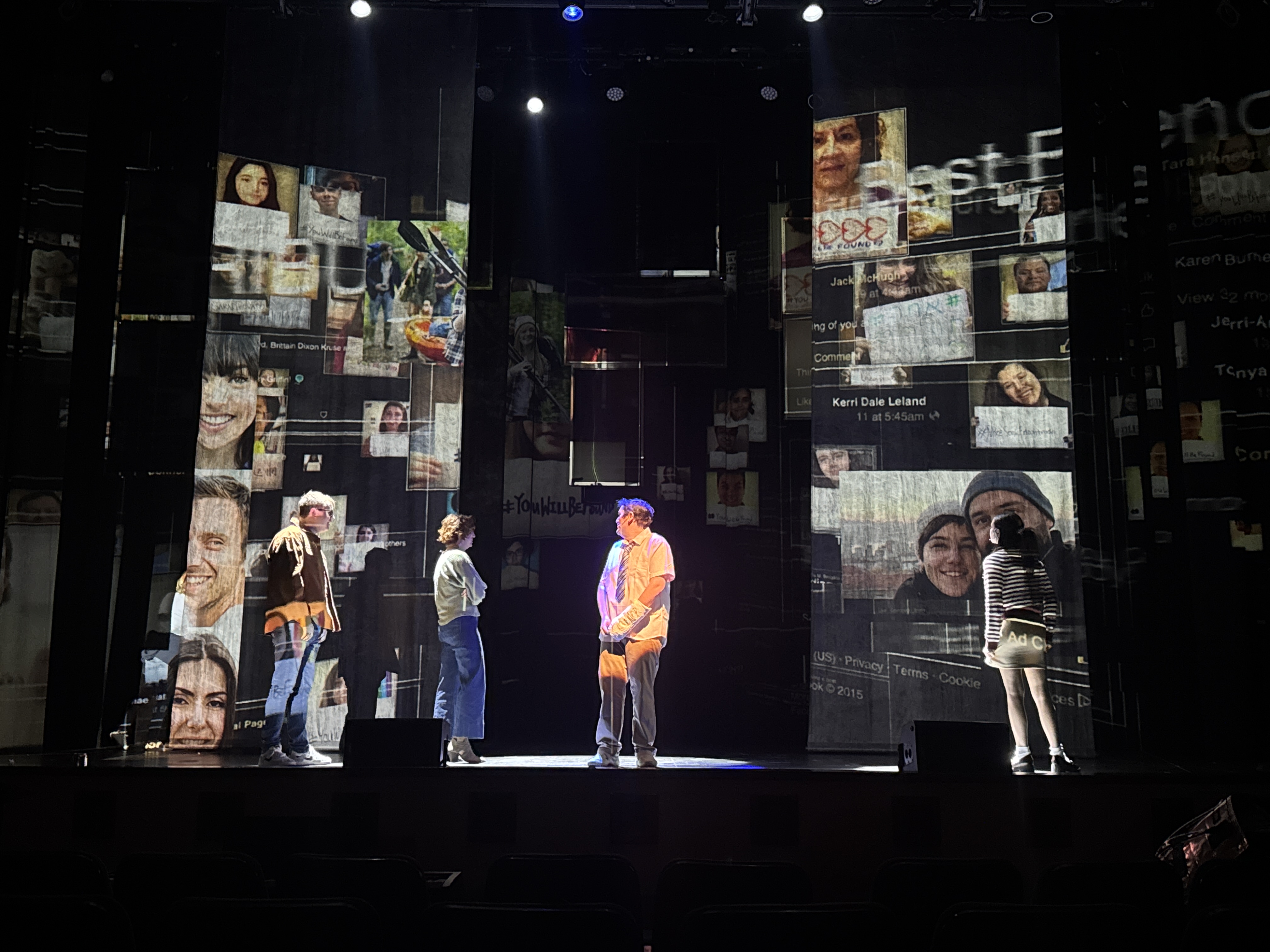
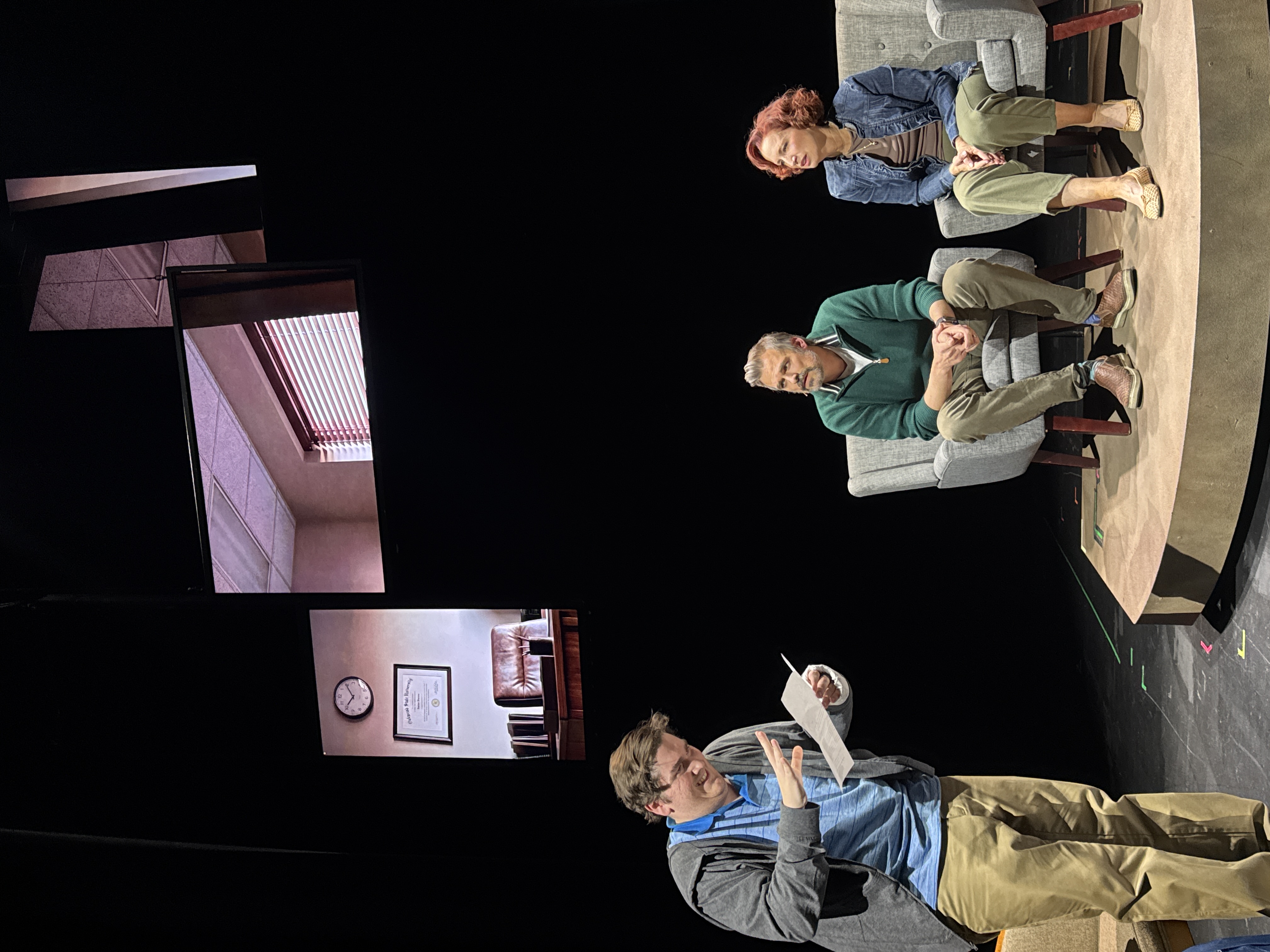
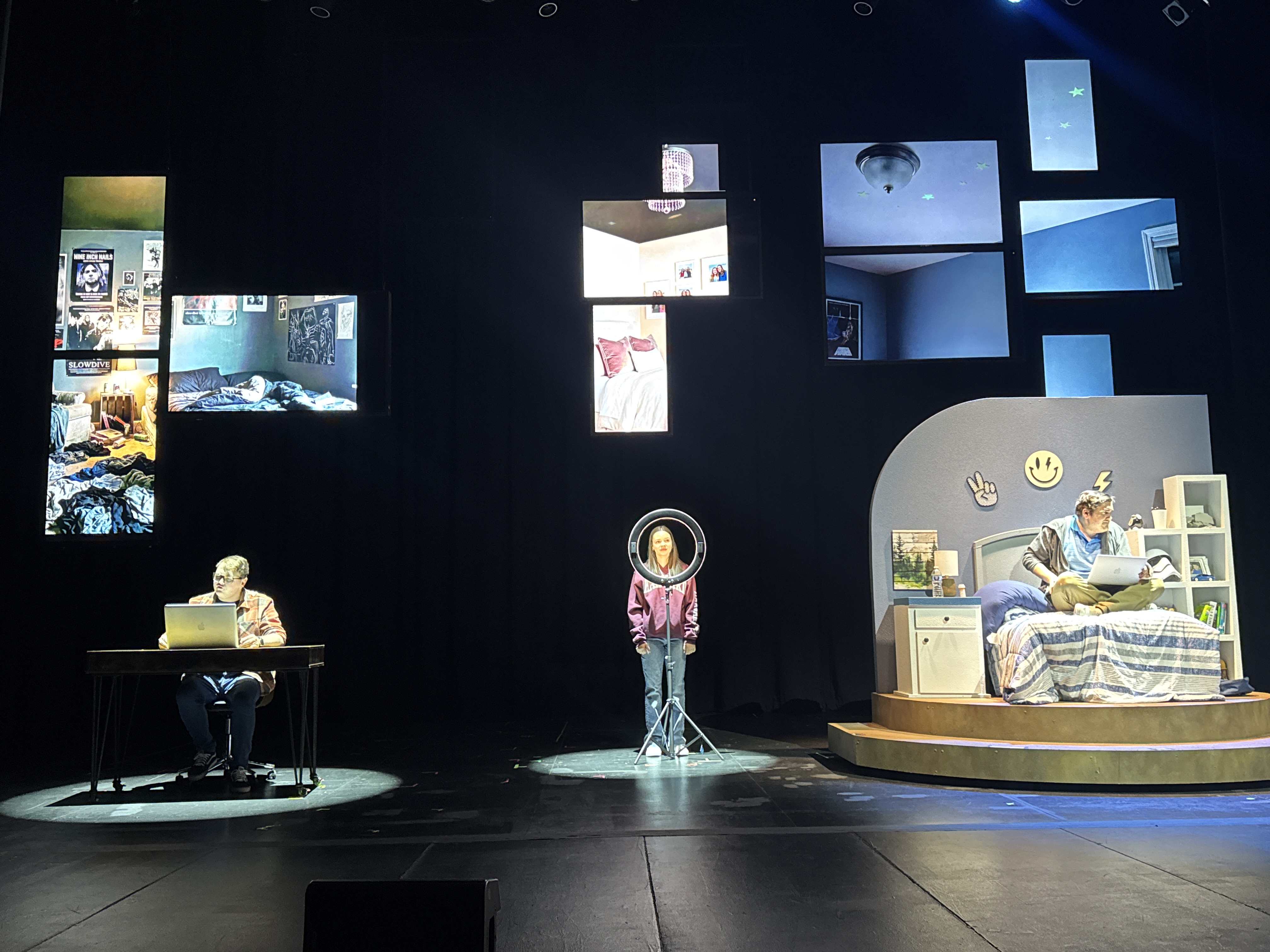
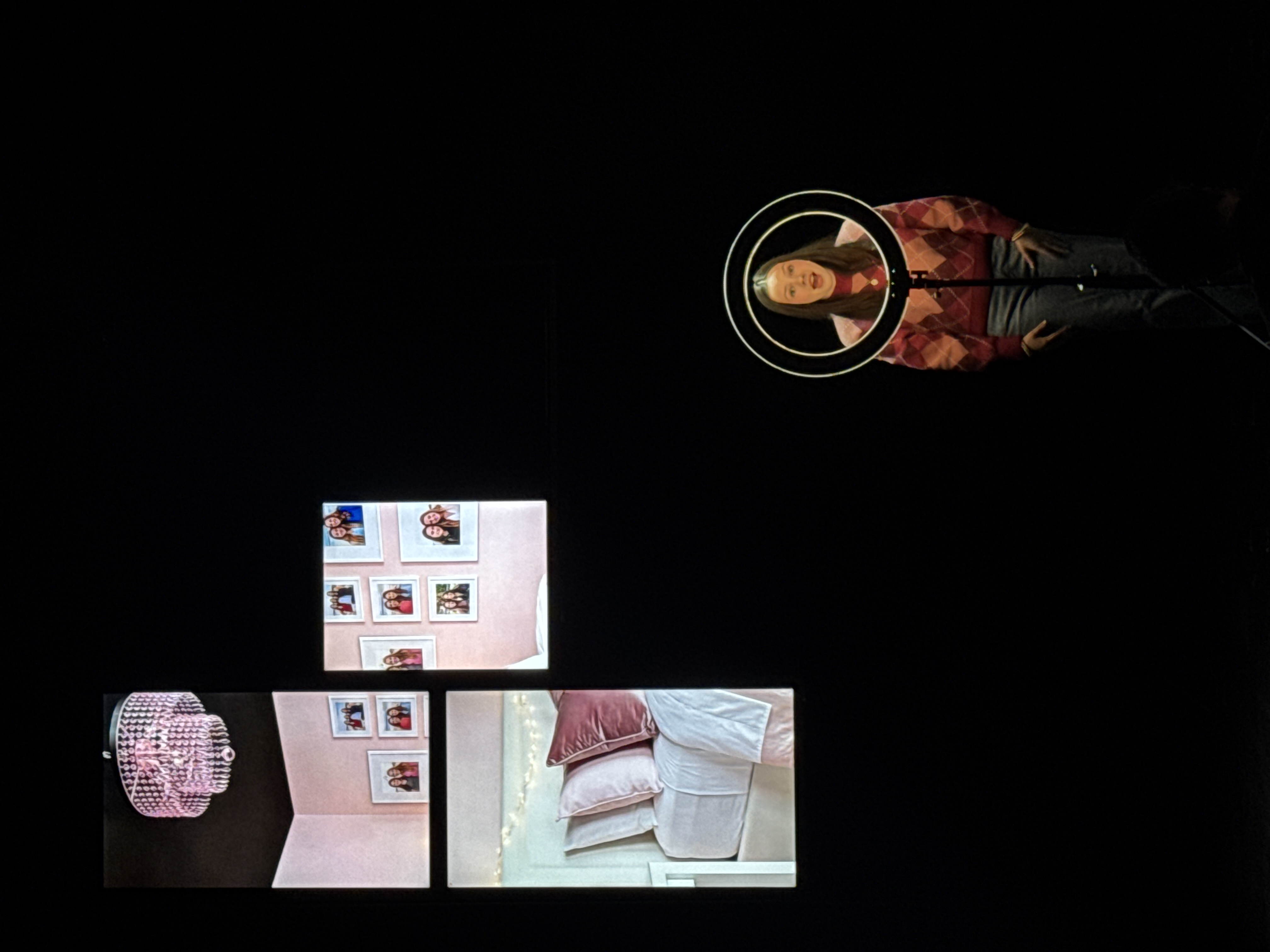
Projection Design: Jeff Tidwell's Inversion
Here's where the craft conversation gets interesting. The original Broadway production — Peter Nigrini's projection design at the Music Box — used screens to externalize Evan's social media amplification. You saw the lie go viral in real time: cascading faces, notification floods, the visual grammar of 2015-era internet fame. It was a dramaturgical choice that made the audience complicit in the mechanism.
Jeff Tidwell inverts this entirely. His design renders interiority, not exteriority. Where Nigrini showed you the world amplifying Evan's lie, Tidwell shows you what the lie feels like from inside Evan's head — fragmentation, memory as texture, the unreliable layering of an anxious mind processing its own deception.
The most instructive moment is "You Will Be Found." On Broadway, this number cascades — it's built to overwhelm, and Nigrini's design delivered that overwhelm through visual accumulation. Tidwell goes still. The held images create a silence that the orchestra cannot. It's a design philosophy, not an accident, and it reveals Tidwell's 40 years of professional experience: knowing when not to move is harder than knowing when to.
Lighting: Jeremy Jones and the Infrastructure Question
Jeremy Jones' lighting design brings a professional infrastructure that reshapes the room. Jones — who got his start at this same Summerlin venue in 1996 before installing Cirque du Soleil's O at Bellagio and running the Miss Saigon National Tour — understands how to light for emotional precision in a space that wasn't built for it. His cues are tight, his color choices support Tidwell's projection work without competing with it, and the transitions between scenes maintain the production's intimate register.
This is the kind of design collaboration that elevates community theatre from "adequate" to "coherent." When your lighting designer and your projection designer are making the same argument, the audience feels the result even if they can't articulate why.
The Performances
Gus Pappas plays Evan with something refreshingly opaque — he doesn't perform anxiety so much as inhabit it. His program note — about wanting audiences to know "you can have depression/anxiety/panic attacks and still do great things" — isn't theatrical distance. He's in it. The role is technically brutal and he climbs the mountain.
Mary Engelhardt (Heidi Hansen) and Shannon Payette Seip (Cynthia Murphy) carry the show's most structurally demanding scenes. Payette Seip — Off-Broadway debut in Maddie: A New Musical, Beverley Bass in the Western Australian premiere of Come From Away — brings professional scale that anchors Act 2 without dominating the room. These two performers navigate the show's hardest dramaturgical problem: making the audience care about the adults in a story that's architecturally centered on the teenagers.
Tristen Serpa (Connor Murphy, Boston Conservatory at Berklee) finds the right weight for a role that exists mostly as posthumous projection. Emma Phillips makes Zoe real rather than structural — a harder task than it appears, because the book doesn't always give Zoe room to be a person rather than a function. Brandon Albright (Larry Murphy) grounds the family dynamics. Trevor Rounds' Jared gives the comedy somewhere to land without becoming a relief valve.
Khloe Judd, 17, a student at Las Vegas Academy of the Arts with professional credits at Majestic Repertory Theatre and the Smith Center, plays Alana Beck with an authority that belies her age. This is a performer to watch.
Music Direction: Holly Stanfield's Pit
Holly Stanfield — Stephen Schwartz's 2021 Musical Theatre Teacher of the Year — leads a pit that doesn't buckle under the Pasek & Paul score's demands. The orchestrations require precision and dynamic range, and Stanfield's ensemble delivers both. The balance between pit and performers is carefully managed: you can hear the lyrics, which in a show this text-dependent is not a small achievement.
The Case This Production Makes
Jeff Tidwell — one of BSC's founding board members — produced How to Dance in Ohio, which moved to Broadway. That fact establishes a context: this is a community theatre company that has already demonstrated it can operate at professional scale when the material demands it.
This Dear Evan Hansen is not a professional production. It is, in stretches, a very good one. And the distinction matters — not as a qualifier, but as a description of what community theatre can achieve when the creative team makes coherent choices and the performers commit fully to the vision.
The weaknesses are the show's as much as the production's. The second act velocity problem — a structural inheritance from the book — persists. But the things that could have gone wrong and didn't — the design integration, the pit, the performances that genuinely land — those belong to this production.
Production Credits
* Projection design: Jeff Tidwell. Original Broadway projection designs licensed through Broadway Media; additional original designs by Jeff Tidwell. The result blends the visual language of the original Broadway production with a fresh, more modern approach tailored to this venue and production.
Summerlin Library and Performing Arts Center · 1771 Inner Circle Drive, Las Vegas, NV 89134
Schedule: Thu–Fri 7:30pm · Sat 2pm & 7:30pm · Sun 2pm · Special Mon Apr 13 7:30pm
April 2: Moderated Language Performance
Through April 19, 2026
Tickets: dearevanhansen.vegas · 844-228-9849 · inquiry@greenroomcritic.com
Content advisory: Teen suicide, mental health, substance use. Rated PG-13 (MTI). Hope Means Nevada (hopemeansnevada.org) representatives at select performances. Crisis line: 988.